Why Most Attendees Leave Empty-Handed: The Hidden Architecture of Networking Failure
The badge is printed. The booth is booked. The business cards are stacked neatly in a jacket pocket. And yet, at the end of a well-attended industry event, an uncomfortable truth surfaces for a significant portion of participants: they leave with no new relationships worth pursuing.
This outcome is not a character flaw. It is not the result of poor social skills or a lack of ambition. In most cases, it is the direct consequence of a venue environment that was never designed to support genuine human connection in the first place.
Understanding why networking fails at scale — and how thoughtful venue design can reverse that failure — is one of the most underappreciated conversations in the events industry today.
The Invisible Ceiling That Stops Conversations Before They Start
Networking at large events is, paradoxically, harder than networking in smaller settings. The sheer density of people creates a kind of social paralysis. Psychologists refer to this as "diffusion of responsibility" — when surrounded by hundreds of potential conversation partners, individuals often feel less compelled to initiate contact with any single one of them. The opportunity feels abundant, so urgency disappears.
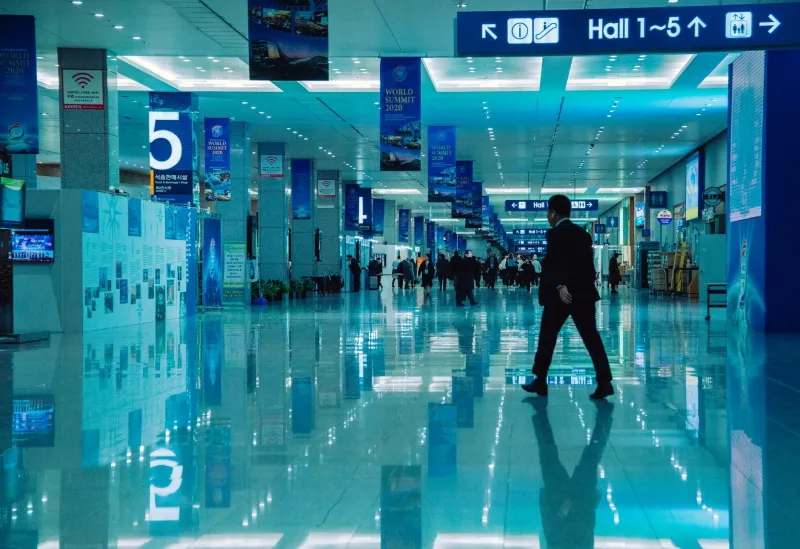
But the physical environment amplifies this effect dramatically. Wide-open exhibition halls with uniform lighting, long uninterrupted rows of booths, and minimal seating create what designers sometimes call "transit zones" — spaces optimized for movement rather than pause. People walk through them efficiently. They do not linger. And lingering, it turns out, is precisely where relationships begin.
When a venue fails to provide natural stopping points — moments of deliberate pause built into the circulation path — attendees remain in perpetual motion. They complete the loop, collect a handful of brochures, and exit the floor having spoken to almost no one outside of pre-scheduled meetings.
Lighting Does More Than Illuminate
The role of lighting in social behavior is well-documented in environmental psychology research. Harsh overhead fluorescent lighting — still common in many convention halls across the United States — signals urgency and efficiency. It is the lighting of airports and supermarkets, spaces designed for transaction rather than conversation.
Contrast that with warmer, lower-intensity lighting in defined zones, and the behavioral shift is measurable. Attendees slow down. They make eye contact more readily. They are more likely to accept an offered handshake or remain in a conversation past the initial pleasantry.
Venues that invest in variable lighting systems — allowing event organizers to shift ambiance between general session lighting and softer, more intimate settings during networking periods — consistently report higher attendee satisfaction scores related to the social experience of the event. This is not coincidence. It is cause and effect.
The Strategic Function of Seating
Seating arrangements communicate social expectations before a single word is exchanged. Long rows of chairs facing a stage signal passive reception. Clusters of chairs arranged at conversational angles signal participation. The distinction matters enormously in the context of networking.
Many venues default to theater-style configurations because they maximize capacity per square foot. But this efficiency comes at a significant relational cost. When attendees have no comfortable place to sit in proximity to one another — outside of a formal session — they default to their phones, their booths, or the nearest exit.
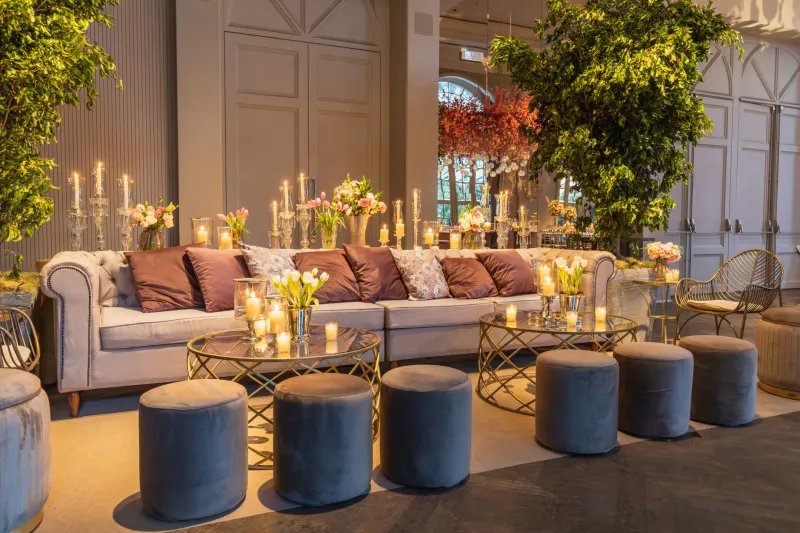
Strategically placed lounge areas, high-top tables near traffic corridors, and semi-enclosed seating clusters positioned at natural decision points in the floor plan serve a specific function: they give attendees permission to stop. They create the conditions for the spontaneous conversation that no amount of structured networking programming can fully replicate.
The best venue designs treat seating not as a logistical afterthought but as a relationship infrastructure investment.
Circulation Patterns as Conversation Architecture
How people move through a space determines who they encounter and for how long. This is not incidental — it is one of the most powerful tools available to venue designers and event planners.
A floor plan that funnels all foot traffic through a single central corridor creates bottlenecks that feel frustrating rather than fortuitous. Attendees push through rather than pause. Contrast this with a layout that distributes traffic across multiple pathways, each anchored by a distinct destination — a coffee station, a featured demonstration area, a curated lounge — and the social dynamic shifts entirely.
When people arrive at a destination, they arrive with shared context. Two professionals who both stopped at the same specialty coffee bar have an immediate, low-stakes conversation opener. The environment has done the relational heavy lifting before either party has said a word.
This is the principle behind what event designers call "programmed collision" — engineering the floor plan so that the right kinds of accidental encounters happen with meaningful frequency. It is not manipulation. It is hospitality at an architectural level.
The Noise Problem Nobody Wants to Admit
Acoustics remain one of the most neglected dimensions of networking-friendly design. A room where ambient noise levels require raised voices to sustain a conversation is a room where conversations end prematurely. The cognitive load of shouting over background noise is real, and most people will disengage from a conversation before they will sustain the effort of projecting over it.
Venues that incorporate acoustic paneling, sound-dampening materials, and designated quiet zones — areas explicitly designed for focused conversation rather than passive attendance — give attendees a resource they rarely knew they needed until they experienced it. The feedback is almost universally positive: professionals describe these spaces as places where they "actually got to talk" in contrast to the broader floor.
This distinction — between being physically present in a room full of people and actually connecting with them — is the entire gap that smart venue design is designed to close.
What Satisfaction Scores Are Actually Measuring
When post-event surveys reveal low satisfaction with networking opportunities, the instinct is often to address programming: add a speed-networking session, extend the cocktail hour, build a more structured matchmaking component. These interventions have value. But they treat the symptom rather than the cause.
Attendees who leave an event with meaningful new contacts almost always describe an environment that made connection feel natural — where they stumbled into conversations rather than forcing them, where the space itself seemed to encourage interaction. This is the fingerprint of intentional venue design.
For event organizers evaluating venue partners, the questions worth asking go beyond square footage and catering minimums. Does the floor plan create natural gathering points? How does the venue handle acoustic management during networking periods? Is the lighting system flexible enough to support different social contexts throughout the day?
These are not aesthetic questions. They are strategic ones.
Building a Venue That Works as Hard as Your Attendees Do
At Angelina Expo Center, the belief that guides our approach to space is straightforward: the environment should do a portion of the relational work so that attendees can focus on doing the rest. Every layout decision, every lighting specification, every seating cluster is evaluated against a single question — does this make it easier for two professionals to begin a conversation they would not otherwise have had?
The networking ceiling that limits so many event attendees is real. But it is not inevitable. It is, in most cases, a design problem — and design problems have design solutions.
The events that generate the most lasting professional value are rarely the ones with the largest attendance figures or the most impressive keynote lineups. They are the ones where the environment quietly conspired to make connection feel effortless. That is the standard worth building toward.