When Crowds Become Barriers: The Counterintuitive Science of Connection at Large-Scale Events

The Illusion of Abundance
There is a persistent assumption in the events industry: the larger the crowd, the greater the opportunity. Organizers celebrate sold-out registrations. Exhibitors equate foot traffic with pipeline. Attendees arrive expecting that sheer volume will work in their favor.
Yet something quietly contradicts that assumption once the doors open.
Professionals who attend massive industry gatherings — the kind that fill every square foot of a sprawling convention hall — frequently report the same unsettling experience afterward. They spoke with dozens of people. They collected a fistful of business cards. And they left without a single conversation that felt worth continuing.
This is not a failure of effort. It is a failure of environment.
What Behavioral Science Actually Tells Us
Social psychologists have long studied how crowd density affects human behavior, and the findings are not flattering for oversized events. When individuals perceive themselves as one face among thousands, a cognitive phenomenon known as diffusion of responsibility takes hold. The sense that any given interaction is consequential diminishes sharply. Why invest thirty minutes in a meaningful dialogue when there are hundreds of other booths to visit, dozens of other panels to catch, and no structural reason to slow down?
The result is what researchers sometimes call "shallow breadth" — a wide surface of contact with very little depth beneath it. Attendees optimize for volume because the environment implicitly encourages it. Conversations are shortened. Follow-up intentions fade before the conference badge is even removed.
Contrast this with environments where the attendee pool is deliberately bounded. When professionals sense that the room contains a finite, curated group of peers, the calculus shifts entirely. Each conversation carries more perceived weight. The likelihood of encountering the same person twice — at lunch, in a hallway, at an evening reception — transforms strangers into acquaintances and acquaintances into genuine contacts.
The Data Behind Connection Quality
Surveys conducted across the trade show and conference industry consistently reveal a gap between attendance size and attendee satisfaction when it comes to networking outcomes. Events with registration counts in the tens of thousands often score lower on measures of "meaningful professional connections made" than regional or sector-specific gatherings that draw a fraction of that audience.
This is not simply a matter of preference. The business outcomes attached to those connections tell an equally clear story. Partnerships formed at mid-sized industry events tend to progress more quickly through the relationship-building stages. Decision-makers who meet in settings where they are not competing with ambient chaos for each other's attention are measurably more likely to schedule follow-up conversations, refer colleagues, and ultimately close commercial agreements.
The quality-versus-quantity tension in professional networking mirrors what economists describe in other contexts: more options do not always produce better decisions. Choice overload — a concept popularized by psychologist Barry Schwartz — applies directly to the trade show floor. When attendees face an overwhelming number of potential contacts, they often disengage rather than engage more strategically.
How Venue Architecture Shapes Social Behavior
The physical design of an event space is not a neutral backdrop. It is an active participant in determining how people move, pause, and interact.
Oversized venues frequently generate what planners call "dead zones" — stretches of floor or corridor where foot traffic disperses so widely that organic encounters become rare. Attendees drift toward familiar faces or retreat to their phones. The sheer scale of the environment can feel alienating rather than energizing, particularly for professionals who do not arrive with an established network already in place.
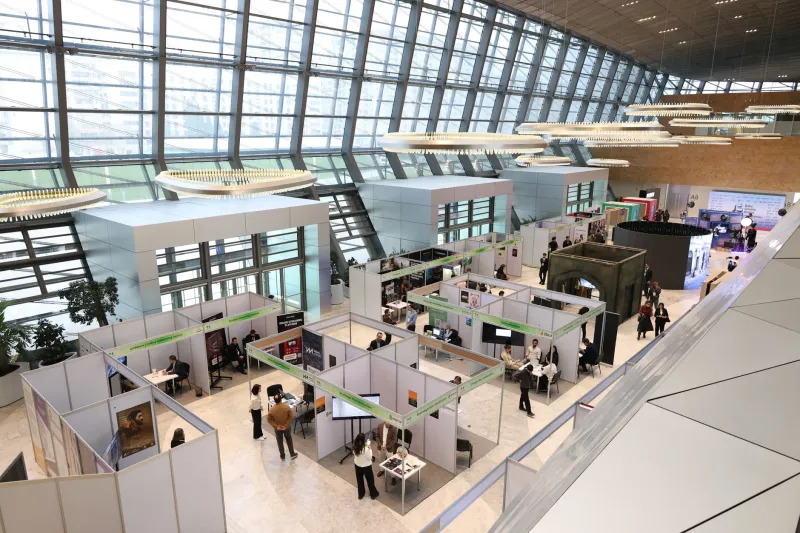
Mid-sized venues, by contrast, allow planners to design with intention. Seating clusters positioned near natural traffic paths encourage incidental conversation. Registration areas that funnel attendees through a single well-designed arrival sequence create shared experience from the first moment. Food and beverage stations, when placed thoughtfully, become social anchors rather than mere logistical necessities.
At Angelina Expo Center, the philosophy behind our space reflects precisely this understanding. Our layout prioritizes flow over volume — creating environments where professionals encounter one another naturally, repeatedly, and in contexts that invite genuine exchange rather than transactional efficiency.
The Curated Crowd as a Strategic Asset
Event organizers who have shifted their thinking from "how many can we fit" to "who belongs in this room" are reporting measurable improvements in post-event outcomes. Registration caps, application-based attendance models, and sector-specific programming all serve the same underlying purpose: they signal to every attendee that the room was assembled with care.
That signal matters more than it might initially appear. Professionals who believe they are among a deliberately selected group arrive differently. Their attention is more focused. Their willingness to invest in conversation is higher. And their sense of accountability to the event — to make the most of it, to contribute rather than merely consume — rises accordingly.
This is the paradox made visible: by limiting access, organizers can dramatically expand the value each attendee extracts from the experience.
Rethinking Success Metrics
The events industry has historically measured success through attendance figures, exhibitor booth counts, and square footage occupied. These are visible, easily communicated metrics. They photograph well and read impressively in post-event reports.
But they are incomplete.
Organizers serious about delivering long-term value to their attendees and exhibitors must begin tracking connection depth alongside connection volume. Post-event surveys that ask not just "how many people did you meet" but "how many conversations do you intend to continue" provide a fundamentally different — and more useful — picture of what actually happened on the floor.
Venues and event professionals who understand this distinction are already operating at an advantage. They are building programs around the conditions that produce meaningful professional relationships, not simply around the conditions that produce impressive headcounts.
Building Events That Actually Deliver
The professionals who leave an event energized, with a handful of relationships worth cultivating, are not luckier than those who leave overwhelmed and underwhelmed. They attended events designed around a different theory of value.
Size, on its own, has never been a reliable proxy for opportunity. The most consequential introductions made at industry gatherings tend to happen in rooms where the environment itself encourages people to slow down, pay attention, and invest in the conversation in front of them — rather than scanning the crowd for the next one.
For organizers, exhibitors, and attendees alike, that understanding is not merely philosophical. It is actionable. Choosing the right venue, at the right scale, for the right audience, is the first and most consequential decision in building an event that actually delivers on its promise.