Hidden in Plain Sight: How Convention Venues Are Becoming the Most Powerful Talent Discovery Engines in American Business
For decades, the dominant conversation around trade shows has centered on transactions—leads generated, contracts signed, partnerships formalized. That framing, while not inaccurate, has always been incomplete. What happens on a well-designed convention floor is far more layered than a series of commercial exchanges. It is, among other things, a live performance of professional capability. And increasingly, the organizations paying closest attention are not buyers or sellers. They are talent scouts.
The idea that a convention center could function as a recruitment pipeline may sound abstract. It is anything but. The physical and programmatic architecture of an event shapes who gets seen, who gets heard, and who gets remembered. Venues that understand this dynamic—and design around it deliberately—are quietly giving the companies that use them a competitive advantage that extends well beyond the close of any single show.
Why the Trade Show Floor Reveals What the Résumé Cannot
A résumé is a curated document. A LinkedIn profile is a managed narrative. Both are useful, but neither captures what a professional actually does when placed under real conditions—when they must explain a complex idea to a skeptical stranger in under three minutes, facilitate a room of competing interests, or recover gracefully from a technology failure in front of a live audience.
Trade shows and industry conferences create exactly those conditions, repeatedly, across two or three compressed days. Emerging professionals who rise to those moments reveal a quality of judgment, adaptability, and interpersonal intelligence that no portfolio or credential can replicate. The problem, historically, has been visibility. Without intentional design, those individuals disappear into the crowd.
This is where venue architecture becomes consequential.
The Spatial Logic of Surfacing Rising Talent
Not all convention spaces are created equal in their capacity to surface emerging professionals. The difference lies in how traffic is directed, where programming is positioned, and what kinds of interactions the physical environment makes possible or impossible.
Venues that concentrate all high-profile programming in large auditoriums, for instance, tend to amplify the voices that are already amplified—keynote speakers with established platforms, panel moderators with institutional backing. These formats have value, but they do little to surface the junior analyst with a genuinely novel market thesis or the mid-career engineer whose technical insight is quietly reshaping an entire product category.
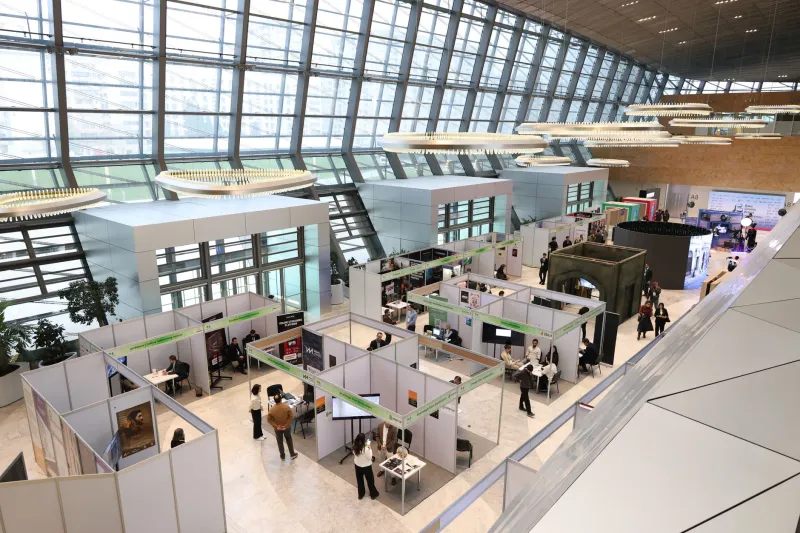
Contrast that with venues that distribute programming across multiple scales—large general sessions paired with smaller, more intimate breakout formats, open-floor demonstration zones, and facilitated roundtables with rotating participation. In these environments, the architecture itself creates multiple stages, and the individuals who perform well on those smaller stages become visible to the people in the room who are paying attention.
At Angelina Expo Center, the deliberate integration of variable-scale spaces is not incidental to our design philosophy—it is central to it. The goal is to ensure that meaningful professional expression is not gatekept by platform size.
Cross-Pollination as a Talent Identification Strategy
Some of the most revealing professional moments at industry events occur not within a single sector's programming track, but at the intersections between them. When a logistics professional engages substantively with a supply chain technology panel outside their immediate specialty, or when a marketing strategist asks a pointed question during an operations-focused session, those moments of cross-disciplinary fluency are significant signals.
Venues that create structured opportunities for attendees from adjacent industries to interact—through mixed-seating lunch formats, cross-track networking sessions, or themed collaboration zones positioned between exhibit halls—generate these moments with greater frequency. The result is an environment where intellectual range, one of the most reliable predictors of long-term leadership potential, becomes observable.
For companies actively searching for their next generation of strategic thinkers, these cross-pollination environments are invaluable. The professional who can hold their own in a conversation that cuts across disciplines is precisely the kind of individual that traditional hiring processes struggle to identify.
Structured Serendipity: Designing the Unexpected Introduction
The phrase "structured serendipity" may sound like a contradiction, but it describes something very specific and very achievable in event design. It refers to the practice of creating conditions in which unplanned, high-value interactions become statistically likely—not left to chance, but not forced either.
This might take the form of a centrally located commons area with comfortable seating and accessible power stations, positioned between two high-traffic programming zones. It might be a curated evening reception with intentional table assignments that place rising professionals alongside senior decision-makers. It might be a morning coffee station positioned adjacent to a live demonstration of emerging technology, where the act of watching together creates a natural conversational opening.
Each of these design choices increases the probability that a talented but less-established professional will find themselves in genuine dialogue with someone who has the authority to recognize and act on what they observe. That is not luck. That is architecture.
What Forward-Thinking Companies Are Already Doing
Organizations on the leading edge of talent strategy have begun treating industry events as active scouting environments, not passive ones. They are sending team members to conferences not only to exhibit or attend sessions, but to observe—to watch how professionals handle the informal spaces, how they navigate disagreement in panel Q&A, how they introduce themselves and follow up within the same event window.
Some companies have formalized this practice, building internal frameworks for documenting emerging professionals identified at industry events. Others operate more informally, but with the same underlying intention: the trade show floor is a live audition, and the audience includes people with the authority to extend invitations that change careers.
For this approach to work at scale, the venue must cooperate. An environment that fragments attendees, creates bottlenecks, or defaults to passive consumption formats will suppress the very behaviors that reveal high-potential individuals. An environment designed for active participation, visible contribution, and genuine exchange will surface them.
The Compounding Return on Visibility-Centered Design
There is a compounding dynamic at work when venues consistently produce these kinds of talent discovery moments. Organizations begin to associate certain events—and by extension, certain venues—with high-quality professional exposure. They return not just because the exhibit space is well-managed or the catering is reliable, but because the events held there consistently put them in contact with the kind of people they want to know.
This reputation is not built through marketing. It is built through repeated experience. And it represents one of the most durable forms of venue value that exists—an asset that grows more valuable with each successive event cycle.
At Angelina Expo Center, we approach this not as a byproduct of good event management but as a deliberate outcome worth designing toward. The convention floor has always been a place where industries connect. Our ambition is to ensure it is equally a place where the next generation of those industries becomes visible—to themselves, and to the organizations ready to invest in them.
The talent is already in the room. The question is whether the room is designed to let you find it.