Unplanned and Unforgettable: How Spontaneous Trade Show Conversations Drive More Revenue Than Scheduled Meetings
Photo: Internet Archive Book Images, No restrictions, via Wikimedia Commons
Every experienced trade show professional has a version of the same story. They flew in with a packed calendar — back-to-back booth appointments, a keynote to attend, two pre-scheduled dinners. Then, somewhere between the registration desk and the main exhibit hall, a stranger made a comment about the badge lanyard, the two laughed, exchanged cards, and three months later signed a contract worth more than anything that had been formally arranged.
This phenomenon is not coincidence. It is, in fact, one of the most economically significant — and least strategically understood — dynamics in professional events today.
The Science Behind Serendipitous Connection
Behavioral economists and organizational psychologists have long studied what researchers at MIT's Human Dynamics Laboratory described as "collisions" — unplanned interactions between individuals who would not have otherwise connected. Their findings, drawn from workplace proximity studies, translate directly to the trade show environment: spontaneous, low-stakes interactions between professionals activate a different kind of trust than formal introductions do.
When two executives meet in a scheduled booth visit, both parties arrive with prepared talking points, a degree of defensiveness, and clearly defined objectives. The dynamic is transactional from the first handshake. By contrast, a conversation that begins organically — over a shared frustration with the badge scanner, a mutual curiosity about a nearby exhibit, or a chance overlap in the lunch line — begins without agenda. That absence of agenda is precisely what makes it valuable.
Research from the Professional Convention Management Association (PCMA) supports this framing. In attendee surveys conducted across major US trade shows, respondents consistently rated "unplanned conversations with other attendees" among the top three most valuable aspects of in-person event attendance — ranking above scheduled programming in several industry verticals. More tellingly, follow-up surveys conducted 90 days post-event found that a disproportionate share of deals, partnerships, and referrals traced back to those unplanned moments rather than to formally arranged meetings.
What the Numbers Actually Show
Quantifying the ROI of spontaneous networking is admittedly more complex than measuring booth traffic or session attendance. Yet the data, when assembled carefully, paints a compelling picture.
A 2022 study published by the Center for Exhibition Industry Research (CEIR) found that exhibitors who reported "high levels of unplanned attendee interaction" — defined as conversations initiated outside the booth environment — generated an average of 27 percent more qualified leads per show than those who relied primarily on scheduled appointments. The same study noted that deals originating from spontaneous interactions had a shorter average sales cycle, a finding researchers attributed to the elevated personal rapport established during the initial encounter.
For attendees on the buyer side, the economics are similarly striking. When procurement officers and business development executives were asked to trace their most recent vendor partnerships back to their origin point, nearly 40 percent identified a moment of informal contact at an industry event — not a cold email, not a scheduled demo, not a formal RFP response.
Venue Design as a Revenue Variable
If spontaneous connection generates measurable economic value, then the physical environment in which those connections occur is itself a strategic business asset. This is a principle that forward-thinking event venues have begun to operationalize deliberately.
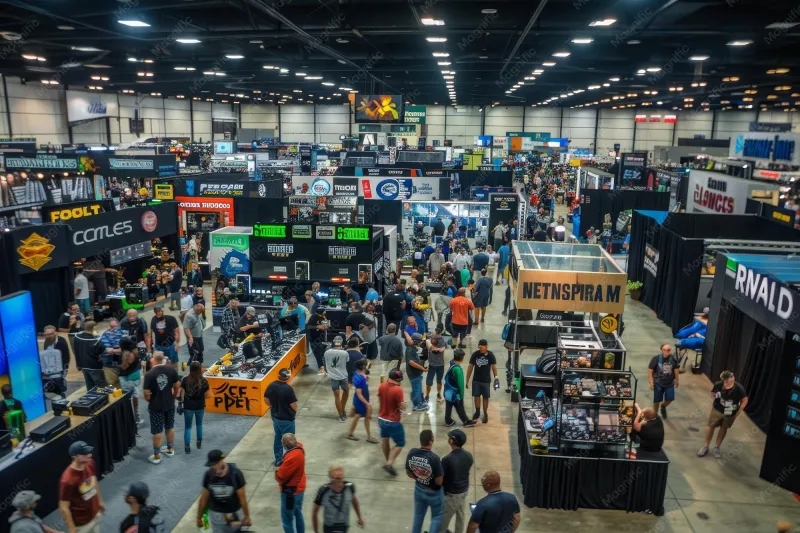
The layout decisions that seem purely logistical — where to place registration, how wide to make the transition corridors, whether to cluster food and beverage stations at the periphery or the center of the floor — carry significant implications for the frequency and quality of unplanned interactions. Venues that create what designers call "dwell zones," areas where attendees naturally slow down, linger, and become open to conversation, are functionally engineering the conditions for serendipity.
At Angelina Expo Center, this philosophy informs how exhibitor floor plans are configured and how common areas are positioned relative to high-traffic session rooms. The goal is not simply to move people efficiently from one point to another, but to create the kind of productive friction that encourages two professionals heading in different directions to pause, notice each other, and begin a conversation that neither had planned.
Common design elements that support this outcome include:
- Open lounge clusters positioned at natural crossroads between exhibit halls and breakout session rooms
- Single-point refreshment stations that draw diverse attendee segments into shared waiting spaces
- Intentionally narrow transition corridors that slow foot traffic and increase the likelihood of eye contact and acknowledgment
- Informal seating arrangements near exhibit entrances that invite attendees to sit, observe, and become approachable
Each of these elements reflects a deliberate understanding that the most valuable conversations at an industry event are often the ones that were never scheduled.
Case Studies Worth Examining
The abstract argument becomes more concrete through specific examples. Consider the experience of a mid-sized logistics technology firm that attended a supply chain conference in the South. Their team arrived with eight scheduled booth meetings and a clear focus on a narrow buyer segment. By the end of day one, they had made contact with a regional freight broker — not in their target profile — who had overheard a hallway conversation about last-mile delivery challenges. That broker introduced them to a national retail chain the following morning. The resulting partnership, finalized five months later, exceeded the combined value of all eight scheduled meetings.
Or consider the experience reported by a healthcare equipment manufacturer at a medical devices exposition. A product manager waiting for a shuttle bus struck up a conversation with a hospital procurement director who had just left a session they both found underwhelming. The shared critique of the presentation became the entry point for a two-hour dinner conversation and, ultimately, a pilot program that expanded into a multi-site procurement agreement.
Neither of these outcomes was predictable. Both were made possible by proximity, timing, and an environment that allowed the conversation to happen naturally.
Preparing to Be Spontaneous
There is an apparent paradox in advising professionals to prepare for unplanned conversations, yet the most effective trade show attendees do exactly that. They arrive with a clear sense of their own value proposition — not a rehearsed pitch, but a genuine and concise understanding of what they do and why it matters — so that when an unexpected opening presents itself, they can step into it without hesitation.
Practical preparation for spontaneous networking might include:
- Refining a conversational opener that is curiosity-driven rather than sales-oriented
- Researching the general attendee profile of the event so that unexpected connections can be quickly contextualized
- Building white space into the schedule — leaving room between formal meetings for the unstructured time where serendipity actually operates
- Following up within 24 hours of any meaningful unplanned conversation, while the context is still fresh for both parties
The Underappreciated Asset
The trade show industry invests enormous resources in programming, production, and logistics. Exhibitors spend months preparing booth materials and rehearsing presentations. Attendees negotiate travel budgets and block off calendar time. Yet the moment that most frequently justifies all of that investment — the chance encounter that becomes a career-defining partnership — receives almost no strategic attention at all.
Recognizing the economic weight of spontaneous connection is not a reason to abandon structured programming. It is a reason to design events, and the venues that host them, with equal intentionality around the spaces in between. Because in those unscheduled moments, where two professionals meet without agenda and discover unexpected alignment, some of the most consequential business relationships in any industry quietly begin.