The Physical Advantage: Why In-Person Trade Shows Are Outperforming the Digital Experiment
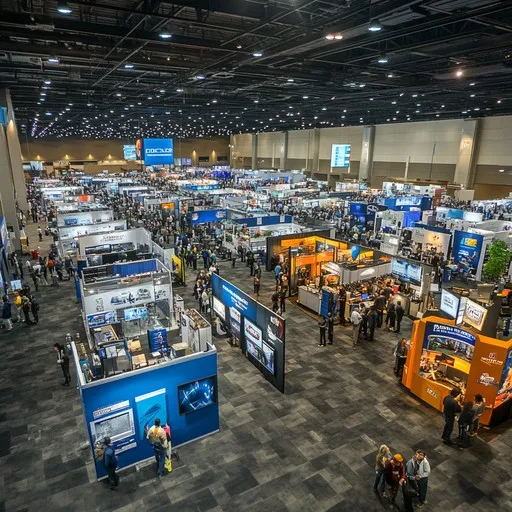
Photo: busy trade show exhibition hall with exhibitors and attendees networking, via images.stockcake.com
For a period between 2020 and 2022, the events industry underwent what many described as a permanent transformation. Virtual platforms proliferated, digital booths replaced physical ones, and industry analysts declared that the future of professional gatherings had irrevocably shifted to the screen. Convention centers were quiet. Exhibition halls sat empty. And a consensus formed, at least in certain corners of the business media, that the in-person trade show was an artifact of a pre-pandemic era.
That consensus has since been challenged — not by sentiment or nostalgia, but by data.
Attendance Figures Tell a Clear Story
Since 2022, trade show attendance across the United States has rebounded with notable strength. The Center for Exhibition Industry Research (CEIR) reported that by late 2023, in-person event attendance had recovered to levels approaching or exceeding pre-pandemic benchmarks in several major sectors, including manufacturing, healthcare, and technology. Meanwhile, platforms that had invested heavily in virtual event infrastructure began scaling back, citing underwhelming engagement and poor conversion rates.
The numbers are not merely a reflection of pent-up demand. They represent a recalibration of how professionals and companies understand the purpose of a trade show in the first place.
What Virtual Events Got Wrong
Virtual exhibitions solved a logistical problem: they allowed people to attend from anywhere, at any time, without the cost of travel or accommodation. On paper, this represented an improvement in accessibility. In practice, it revealed a fundamental misunderstanding of why people attend trade shows.
Attendees do not travel to a convention center solely to receive information. Information is available in abundance through webinars, white papers, and on-demand video. What they seek is the irreplaceable quality of physical presence — the handshake that precedes a partnership, the spontaneous hallway conversation that evolves into a contract, the live product demonstration that resolves a year of uncertainty about a purchasing decision.
Virtual formats struggle to replicate these moments. Chat functions and video networking rooms approximate human interaction without achieving it. Attention is fragmented across open browser tabs, competing notifications, and the general low-stakes atmosphere of an event attended from a home office. Engagement metrics from virtual platforms — click-through rates, session durations, and virtual booth visits — consistently fall short of their physical equivalents when measured against conversion to actual business outcomes.
The ROI Divergence
Return on investment is where the divergence becomes most apparent. Exhibitors at physical trade shows report higher-quality lead generation, stronger brand recall among attendees, and more advanced conversations at the point of contact. A prospect who spends twenty minutes at a physical booth, handles a product, and speaks directly with a company representative is significantly further along the sales journey than one who clicks through a digital display.
For buyers, the calculus is equally compelling. Physical events compress months of vendor research into a single, efficient experience. Walking a trade show floor allows procurement professionals and decision-makers to evaluate multiple suppliers in rapid succession, compare offerings side by side, and ask questions in real time. That efficiency has measurable value — value that a curated list of virtual vendor sessions cannot replicate.
The Hybrid Question
Hybrid events — those that combine a physical presence with a simultaneous virtual component — were widely promoted as the ideal synthesis. The reality has proven more complicated. Producing a high-quality hybrid event requires substantially greater resources than a purely in-person gathering. Two distinct audiences must be served simultaneously, and the needs of those audiences are often in direct tension. Camera placement that serves a virtual viewer may obstruct sightlines for in-person attendees. Networking programming designed for physical participants excludes those joining remotely.
Many organizers who invested in hybrid infrastructure have since concluded that the virtual component, despite its theoretical appeal, delivers a diluted experience for both audiences. The practical result has been a gradual retreat toward fully in-person formats, with virtual access offered only as an archival option rather than a true parallel event.
The Venue as a Strategic Asset
Underlying all of this is a recognition that the physical venue itself carries strategic weight. The decision to hold an event at a purpose-built convention facility communicates seriousness of purpose. It signals investment, permanence, and the expectation of substantive engagement. Attendees arrive with a different mindset than they bring to a webinar — they have committed time, resources, and professional attention to being present.
This psychological shift is not incidental. It is foundational to the quality of interaction that in-person events generate. When professionals travel to a trade show, they arrive prepared to do business. That preparedness is the precondition for the high-value conversations, partnerships, and discoveries that justify the investment.
Looking Ahead
The events industry is not returning to the past unchanged. Digital tools play a legitimate supporting role — in pre-event registration and communications, in post-event follow-up, and in making archived content accessible to those who could not attend. But these tools are supplements to the physical event, not substitutes for it.
The evidence from the past several years is consistent: when professionals have the choice, they choose to be in the room. They choose the handshake over the chat message, the live demonstration over the product video, and the shared meal over the virtual networking session. That choice is not irrational. It reflects a clear-eyed understanding of where business actually gets done.
At Angelina Expo Center, we have witnessed this return firsthand. The exhibitions and trade shows hosted within our facility have grown in both scale and ambition, attracting exhibitors and attendees who understand that the most consequential professional moments still happen in person. The physical advantage is not a nostalgic preference. It is a competitive reality.