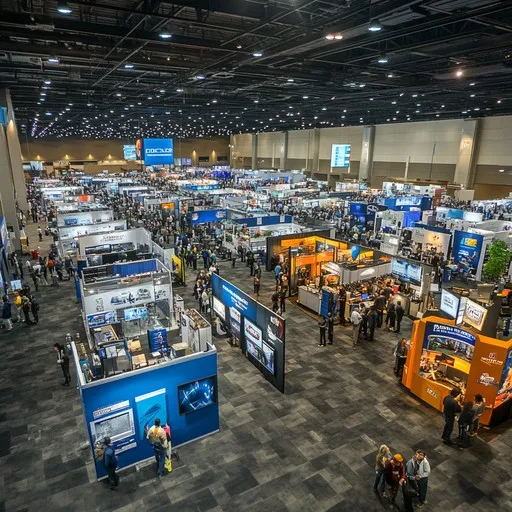
Hybrid Events Are Draining Budgets Faster Than You Think — Here's the Math

Photo: Self Scanned, Public domain, via Wikimedia Commons
The promise was compelling: reach twice the audience by streaming your trade show to remote attendees while hosting the in-person crowd. For many organizations, it sounded like the best of both worlds. In practice, it has proven to be one of the most expensive miscalculations in modern event planning.
Hybrid events — when executed without the proper infrastructure, technical support, and venue capability — are quietly consuming budgets that companies believe they are stretching further. Understanding exactly where that money disappears is the first step toward building a smarter event strategy.
The True Cost of Going Hybrid Without the Right Foundation
When an organization decides to livestream or run a parallel virtual component alongside a live event, the assumption is often that the incremental cost will be modest. A camera crew here, a streaming platform subscription there. What the line-item budget rarely captures is the cascading complexity that follows.
Professional-grade livestreaming requires redundant internet connections, broadcast-quality audio and video equipment, dedicated technical staff, and a content delivery infrastructure capable of handling simultaneous viewers without degradation. Industry estimates suggest that a mid-size trade show attempting to add a credible virtual layer for the first time can expect to spend between $25,000 and $80,000 in technology and staffing costs alone — before a single attendee logs on.
That figure does not account for the time lost by internal staff who are pulled from exhibitor relations and floor management to troubleshoot technical failures. Nor does it reflect the reputational cost of a buffering stream or an audio dropout during a keynote presentation.
Audience Fragmentation: The ROI Killer Nobody Talks About
Beyond the direct financial burden, hybrid events create a structural problem that undermines their core purpose: audience fragmentation.
When attendees are divided between physical and virtual spaces, neither group receives the full value the event was designed to deliver. In-person exhibitors find themselves presenting to a partially distracted live audience whose energy is diluted by the awareness that a secondary event is happening simultaneously on a screen somewhere. Virtual attendees, meanwhile, receive a fundamentally passive experience — they watch rather than participate, observe rather than connect.
Data from multiple post-event surveys conducted across U.S. trade associations consistently shows that virtual-only attendees at hybrid events convert to exhibitor leads at rates between 60 and 75 percent lower than their in-person counterparts. For an exhibitor paying $5,000 or more for booth space and travel, that conversion gap is not an abstraction — it is a direct hit to return on investment.
Event sponsors are beginning to notice. Sponsorship packages tied to hybrid events are facing greater scrutiny, and several major U.S. industry associations have reported difficulty renewing top-tier sponsorships after hosting events where virtual attendance diluted brand visibility and lead quality.
Where the Budget Bleeds Most
A detailed breakdown of where hybrid event costs accumulate most aggressively reveals several pressure points that organizations routinely underestimate.
Technology redundancy is the single largest surprise expense. Professional events cannot afford a single point of failure in their streaming infrastructure. Backup systems, failover internet connections, and on-site technical engineers all carry significant price tags.
Content adaptation is the second major drain. Material designed for an in-person audience — panel discussions with natural back-and-forth, floor demonstrations, networking lunches — does not translate effectively to a screen without significant redesign. Organizations that invest in proper content adaptation for virtual audiences often find they are essentially producing two separate events under one budget.
Staff duplication is a third factor. Managing an in-person event and a virtual event simultaneously requires separate coordination teams, separate communication channels, and separate contingency planning. The operational overhead grows non-linearly with event complexity.
Why Venue Selection Changes the Equation
The organizations that have found a sustainable path through the hybrid challenge share one common decision: they selected venues that treated technology infrastructure as a native capability rather than an afterthought.
Facilities like Angelina Expo Center are built with the understanding that modern events exist at the intersection of physical presence and digital reach. When high-speed connectivity, broadcast-ready staging, and technical support are embedded in the venue's core offering rather than rented piecemeal from outside vendors, the cost structure of a hybrid component changes dramatically.
More importantly, a venue with genuine technical depth allows event planners to make an honest assessment of whether a hybrid component is actually warranted — or whether a fully in-person event, supported by post-event digital content distribution, would generate better returns at lower cost.
The Smarter Model: In-Person First, Digital as a Supplement
A growing number of U.S. event strategists are returning to a framework that prioritizes the live experience as the primary product and uses digital tools selectively rather than simultaneously.
Under this model, the live event is designed and executed to maximize in-person engagement, exhibitor ROI, and attendee networking quality. Post-event recordings, curated highlight content, and on-demand session libraries then extend the event's reach to audiences who could not attend in person — without fragmenting the live experience or inflating the production budget.
This approach requires a venue partner capable of capturing high-quality content during the live event without disrupting the floor experience. It demands clean acoustics, reliable power infrastructure, and flexible staging configurations. These are not amenities — they are operational requirements.
Rethinking the Budget Before the Next Event
For organizations planning their next trade show or conference, the most valuable exercise is a straightforward cost comparison: total expenditure for a hybrid event versus total expenditure for a fully in-person event with a professional post-event content strategy.
In the majority of cases examined across U.S. trade show sectors, the in-person model — when executed in a venue with the right infrastructure — delivers measurably higher exhibitor satisfaction, stronger attendee engagement scores, and more favorable sponsor renewal rates, at a lower total cost.
The hybrid promise was never wrong in principle. The error was in assuming that the benefits could be captured without the investment in infrastructure that makes them real. For most organizations, the financially sound path forward is not a retreat from digital ambition — it is a recognition that in-person events, properly supported, remain the most efficient engine for the outcomes that exhibitors and attendees are actually paying for.